AI in Teaching and Learning: How Artificial Intelligence Is Transforming Education
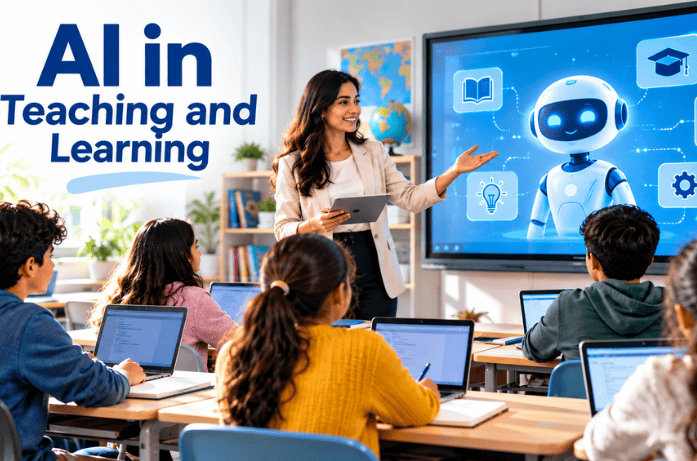
Artificial intelligence is slowly becoming a part of our everyday education, and AI teaching and learning is changing the way teachers teach and students learn. From creating lesson plans and practice questions to explaining difficult topics, AI can make learning more flexible and accessible.
For teachers, AI can save time and help create useful learning materials. For students, it can provide extra explanations, practice, and support whenever they need it. But AI is not here to replace teachers or human thinking. The real value of AI comes from using it wisely and responsibly.
So, how can AI make education better? What are its benefits, and what should teachers and students be careful about?
Let’s explore how AI is shaping the future of education.
What Is AI in Teaching and Learning?
AI in teaching and learning refers to using artificial intelligence technologies to support educational activities.
These technologies can analyze information, generate content, answer questions, recognize patterns, provide feedback, and adapt learning experiences.
For example, a teacher might use an AI tool to:
- Create a lesson plan
- Generate quiz questions
- Develop classroom activities
- Simplify a difficult topic
- Create different versions of an assignment
- Brainstorm examples
- Draft feedback for students
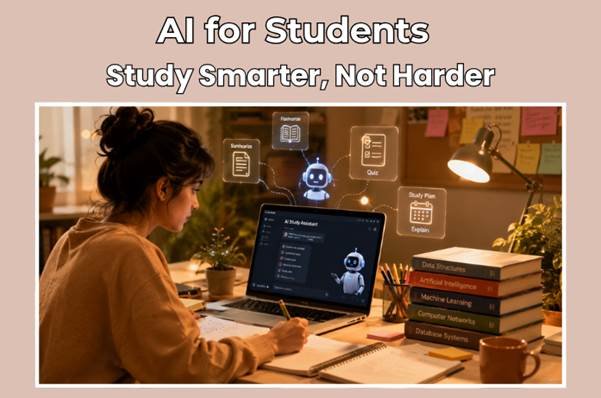
A student might use AI to:
- Understand a difficult concept
- Practice a foreign language
- Generate study questions
- Get explanations at different difficulty levels
- Organize study notes
- Receive feedback on writing
- Explore different perspectives on a topic
The important point is that AI should support learning rather than replace learning.
UNESCO recommends a human-centred approach to generative AI in education, with attention to privacy, safety, equity, ethics, and meaningful educational use.
How AI Is Changing Teaching
Teachers have traditionally spent considerable time preparing materials, creating assessments, checking work, and handling administrative tasks.
AI can assist with some of these activities, giving educators more time to focus on students.
1. AI Can Help Create Lesson Plans
Teachers can use AI to brainstorm lesson structures based on a topic, grade level, and learning objective.
For example, a teacher teaching photosynthesis could ask an AI tool for:
- A beginner-friendly explanation
- A classroom activity
- Five discussion questions
- A short quiz
- A real-world example
The teacher can then review, edit, and adapt the material before using it.
AI therefore becomes an assistant rather than the teacher.
2. AI Can Help Create Personalized Learning Materials
Not every student learns in exactly the same way.
One student may understand a concept through an example, while another may prefer a diagram or step-by-step explanation.
AI can help teachers create different versions of learning materials.
For example:
Advanced learner:
“Explain the water cycle using scientific terminology.”
Beginner learner:
“Explain the water cycle using simple everyday language.”
Visual learner:
“Give me a simple diagram-based explanation.”
This flexibility can make classroom resources more accessible.
3. AI Can Assist With Feedback
Giving individual feedback to every student can be time-consuming.
AI can help teachers identify grammar problems, suggest areas for improvement, or organize common mistakes.
However, teachers should remain involved in the final feedback process.
Human judgment is especially important when feedback involves creativity, reasoning, personal circumstances, or complex academic work.
How AI Is Changing Student Learning
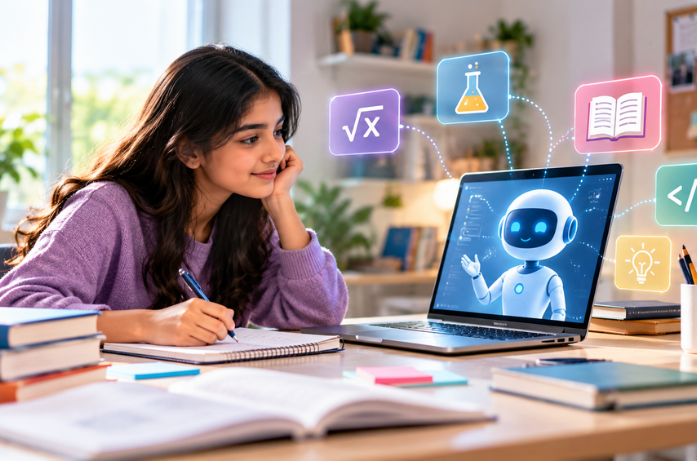
AI isn’t only changing what teachers do. It is also changing how students approach learning.
1. AI May Serve as a Learning Helper
Let’s consider a student who is working on his math lessons at home.
Rather than just trying to find a solution, he may turn to the AI:
Walk me through solving this problem, but do not reveal the answer to me yet.
Thus, the student is actively involved in the learning process.
Similar to this, AI may assist in learning science, history, languages, programming, and a lot of other topics.
2. Students Can Learn at Their Own Pace
In a traditional classroom, the teacher has to manage the pace of an entire group.
AI-powered learning tools can potentially provide additional explanations when a student needs more time.
A student can ask:
- “Explain this more simply.”
- “Give me another example.”
- “Quiz me on this topic.”
- “What mistake did I make?”
- “Give me a harder question.”
This can make learning more interactive.
3. AI Can Support Language Learning
Language learners can use AI to practice vocabulary, grammar, writing, and conversation.
For example, a student learning English could ask an AI tool to act as a conversation partner and correct mistakes after each response.
This can provide additional practice outside the classroom.
Benefits of AI Teaching and Learning
When used responsibly, AI can provide several benefits.
| Area | Traditional Approach | AI-Supported Approach |
| Lesson planning | Mostly manual | AI can help brainstorm and structure lessons |
| Practice | Fixed worksheets | Potentially customized practice |
| Feedback | Teacher-dependent | AI can provide initial feedback |
| Explanations | One classroom explanation | Multiple explanations and examples |
| Study support | Limited to available resources | On-demand assistance |
| Content creation | Time-consuming | Faster drafting and idea generation |
| Accessibility | Requires separate resources | AI can help adapt content |
However, faster does not automatically mean better.
The goal should be better learning, not simply faster completion.
Practical Ways Teachers Can Use AI
Teachers who are new to AI don’t need to transform their entire classroom overnight.
They can start with small, practical experiments.
1. Create Quiz Questions
Ask AI to generate questions based on a lesson and then review them for accuracy.
2. Generate Discussion Prompts
AI can suggest questions that encourage students to explain, compare, debate, or evaluate ideas.
3. Adapt Reading Materials
Teachers can use AI to create simpler explanations for students who need additional support.
4. Brainstorm Classroom Activities
AI can suggest project ideas, experiments, role-playing activities, and group exercises.
5. Create Study Guides
Teachers can use AI to organize major concepts into revision guides while checking the information themselves.
The teacher remains responsible for deciding what students should learn and whether AI-generated material is accurate.
Practical Ways Students Can Use AI
Students can also use AI more effectively by changing how they ask for help.
Using AI the Right Way
Students can get more from AI when they use it to learn, not just to get answers.
1. Ask for explanations: Ask AI to explain difficult topics step by step.
2. Practice with AI: Create quizzes and practice questions to test your knowledge.
3. Check your understanding: Ask AI questions and see where you need more practice.
4. Get feedback: Write your own answer first, then use AI to find areas for improvement.
5. Verify information: Always check important facts using trusted books, teachers, or reliable sources.
The goal is simple: use AI as a learning partner, not a shortcut.
What Are the Risks of AI in Education?
AI offers opportunities, but it also creates real challenges.
Overdependence on AI
If students use AI to complete every assignment, they may lose opportunities to practice independent thinking.
The OECD has highlighted concerns that poorly guided generative AI use can reduce productive struggle and may produce better-looking work without producing deeper learning.
Incorrect Information
AI systems can generate incorrect or misleading information.
Therefore, students should never assume that an AI-generated response is automatically correct.
Academic Integrity
Using and submitting it as your own work raises serious academic AI to write an entire assignment integrity concerns.
Schools and universities need clear policies explaining when AI assistance is acceptable and when it is not.
Privacy
Students and teachers may enter personal or sensitive information into AI tools without realizing how that information could be handled.
UNESCO specifically emphasizes privacy and human-centred safeguards when AI is used in education.
Digital Inequality
Not every student has the same internet connection, devices, paid subscriptions, or access to AI tools.
If AI becomes part of education, institutions need to consider accessibility and equity.
How Can Schools Use AI Responsibly?
A successful AI strategy should begin with educational goals rather than technology.
Instead of asking:
“How can we use AI?”
Schools should first ask:
“What learning problem are we trying to solve?”
For example:
- Do students need more personalized practice?
- Do teachers need help creating resources?
- Are students struggling with research skills?
- Can AI improve accessibility?
- Can technology reduce repetitive administrative work?
Once the problem is clear, educators can decide whether AI is actually the right solution.
The OECD’s 2026 AI literacy framework emphasizes that students need the ability to understand AI, critically evaluate its outputs, and use it ethically and creatively.
Our Perspective
AI can make education smarter, easier, and more personalized when used in the right way. It can help teachers save time and give students extra support when they need it.
But AI should never replace human thinking or teachers. Students still need to ask questions, make mistakes, think independently, and learn from real human guidance. AI should be a learning partner, not a shortcut.
AI Literacy Is Becoming an Essential Skill
The knowledge of AI is equally essential as its usage. Students must realize that AI is not an infallible entity. The lessons on AI must include the following topics:
- Understanding AI
- Knowing how AI operates
- Understanding the limitations of AI
- Learning how to fact-check AI responses
- Recognizing the impact of biases on AI outputs
- Understanding the importance of protection of private data
- Being aware of under what circumstances the use of AI is justified
- Learning how to use AI ethically In short, schools should prepare students to be critical users of AI instead of passive consumers of AI-based information.
AI Should Support Teachers, Not Replace Them
One of the biggest questions surrounding AI in education is whether artificial intelligence will replace teachers.
The more useful question is:
How Can AI Help Teachers Do Their Jobs Better?
AI can make a teacher’s work easier, but it can never replace what makes a great teacher truly special.
Teachers do much more than explain lessons. They encourage students when they feel lost, understand their emotions, answer questions, build confidence, and create a classroom where students feel comfortable learning.
AI can take care of some repetitive tasks, such as creating quizzes, organizing ideas, or preparing basic learning materials. This gives teachers more time to focus on what matters most, their students.
AI can support a teacher, but the human connection will always remain at the heart of education.
The Future of AI in Teaching and Learning
The future will probably not be about choosing between humans and AI.
It will be about learning how humans and AI can work together effectively.
We may see more:
- AI-powered tutoring systems
- Personalized learning platforms
- AI-assisted lesson planning
- Intelligent practice systems
- Automated language practice
- AI literacy courses
- Adaptive assessments
- Accessibility tools
- AI-supported research
- Teacher-AI collaboration
But technological progress alone will not guarantee better education.
The real measure of success will be whether students become more knowledgeable, curious, independent, creative, and capable of thinking critically.
Final Thoughts
AI teaching and learning is changing education, but the real goal is not technology, it is better learning.
AI can help teachers save time and give students extra support, but it should never replace curiosity, creativity, or independent thinking. The best results come when AI works with teachers and students, not instead of them.
The future of education is not about using AI for everything. It is about knowing when AI can help, how to use it responsibly, and when human thinking matters most.
Want to discover more ideas, tools, and insights about the future of education?
keep exploring EdTech Vibe for more helpful guides, tools, and educational insights.
FAQs
1. What is AI in teaching and learning?
AI in teaching and learning means using artificial intelligence to support teachers and students with tasks such as lesson planning, practice, feedback, and explanations.
2. How can teachers use AI in the classroom?
Teachers can use AI to create quizzes, lesson ideas, activities, learning materials, and discussion questions. AI-generated content should always be reviewed before use.
3. How can students use AI for learning?
Students can use AI to understand difficult topics, practice questions, improve writing, and test their knowledge. It works best as a learning assistant, not as a replacement for their own work.
4. What are the disadvantages of AI in education?
AI can provide incorrect information and may lead to overdependence, privacy concerns, or academic integrity issues. Students and teachers should use it carefully and responsibly.
5. Will AI replace teachers?
No. AI can support teachers with repetitive tasks, but it cannot replace the human connection, guidance, understanding, and encouragement that teachers provide.
About the Author
Divya is a passionate writer who enjoys exploring the ways technology is shaping education and everyday learning. Through her writing, she aims to make complex topics like AI and educational technology simple, practical, and easy to understand.
She believes technology is most valuable when it helps people learn with more confidence and curiosity. At EdTech Vibe, Divya shares useful insights, ideas, and practical resources to help teachers, students, and lifelong learners navigate the changing world of education.