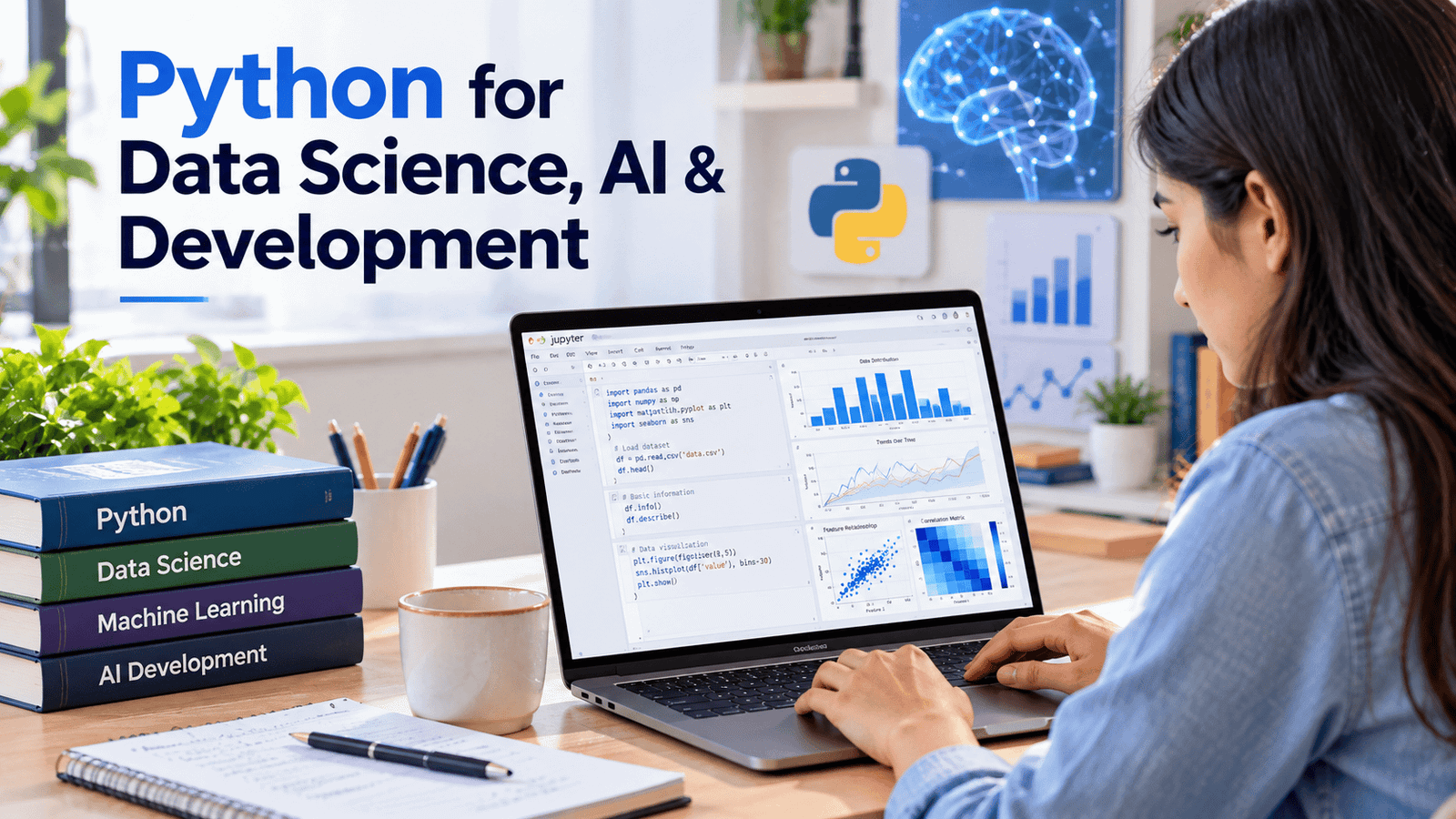
Python has become one of the most useful programming languages for people interested in data science, artificial intelligence, automation, and software development. If you are a beginner looking for a structured way to learn Python, the Python for Data Science, AI & Development Coursera course from IBM is one option worth exploring.
The course is designed to take learners through Python fundamentals and gradually introduce them to practical work with data. According to Coursera, the course covers Python syntax, data types, variables, data structures, functions, object-oriented programming, NumPy, Pandas, Jupyter Notebooks, web scraping, and REST APIs.
What makes this course especially helpful for beginners is the practical orientation of the lessons. Instead of focusing only on theory, the course lets you practice Python with tools commonly used in data-related work.
In this guide, we will explore what the course teaches, who should take it, what skills you can expect to develop, its strengths and limitations, and how you can get more value from your learning experience.
What Is Python for Data Science, AI & Development on Coursera?
Python for Data Science, AI & Development is an IBM course available through Coursera. It is listed as a beginner-level course and is designed for learners who want to build a foundation in Python while connecting programming with data science and AI-related work.
The current Coursera listing describes the course as having five modules, with a flexible learning schedule of approximately two weeks at around 10 hours per week. It also includes assignments and a shareable certificate option.
The course focuses on several important areas:
- Python programming fundamentals
- Data structures
- Programming logic
- Functions and classes
- Working with files
- NumPy
- Pandas
- Jupyter Notebooks
- REST APIs
- Web scraping with BeautifulSoup
- Data collection and analysis
This combination makes it more focused than a general introductory programming course.
What Will You Learn in the Course?
1. Python Basics
The course begins with fundamental Python concepts such as:
- Variables
- Data types
- Expressions
- Operators
- Strings
- Basic syntax
For example, a beginner might start with a simple Python statement:
name = “Alex”
print(“Hello”, name)
Understanding these fundamentals is important because almost every later Python task depends on them.
Python’s official documentation describes the language as an easy-to-learn programming language with a broad standard library and applications ranging from scripting to rapid application development.
2. Python Data Structures
Once you understand the basics, the course moves into data structures such as:
- Lists
- Tuples
- Sets
- Dictionaries
These structures are essential when working with information.
For example, a list can store multiple values:
scores = [85, 90, 78, 92]
students = ["Aarav", "Khushboo", "Divya", "Sonu"]
A dictionary can store related information using key-value pairs:
student = { “name”: “Aarav”, “score”: 85 }
Learning these concepts helps you write programs that can process and organize real-world information.
3. Programming Fundamentals
The course also introduces programming logic through:
- Conditions
- Branching
- Loops
- Functions
- Exception handling
- Objects
- Classes
These topics help learners move from writing simple statements to creating reusable and more structured programs.
For example, a loop can be used to process multiple values:
for score in scores:
print(score)
This type of logic becomes especially useful when working with large datasets.
Python for Data Science: Pandas and NumPy
One of the most important parts of the course is its introduction to Python libraries used for data work.
NumPy
NumPy is widely used for numerical computing in Python. It provides tools for working with arrays and numerical operations.
For someone interested in data science or machine learning, understanding NumPy can provide a useful foundation for later work with more advanced libraries.
Pandas
Pandas is designed for working with structured data. You can use it to load, clean, filter, transform, and analyze datasets.
For example:
import pandas as pd
data = pd.read_csv(“students.csv”)
print(data.head())
A beginner can use Pandas to answer practical questions such as:
- Which students have the highest scores?
- What is the average score?
- Are there missing values?
- How does one group compare with another?
These are the types of tasks that make Python useful beyond simply learning programming syntax.
Working With Jupyter Notebooks
The course also introduces Jupyter Notebooks, a popular tool for learning Python and working with data.
With Jupyter, you can write code, run it, and see the results instantly in the same place. You can also add notes, tables, and visualizations to make your work easier to understand.
For beginners, this makes learning more practical. You can test your code, find mistakes, make changes, and immediately see what happens.
It’s a simple way to learn Python by practicing and experimenting.
Web Scraping and APIs
The course also shows you how Python can be used to collect real-world data from the internet. You will learn how to work with REST APIs and the Requests library to retrieve structured information from online services. It also introduces BeautifulSoup, which can help extract useful information from web pages when scraping is allowed. These skills are valuable because before you can analyze data, you first need to find, collect, and prepare it.
Is This Course Useful for AI?
The answer depends on what you mean by “AI.”
The course provides a Python foundation for AI-related learning, but it is not itself a complete artificial intelligence or machine learning program.
It teaches skills such as Python programming, NumPy, Pandas, data collection, and data analysis. These are useful prerequisites for moving into machine learning and AI.
After building these foundations, learners can continue into topics such as:
- Machine learning
- Deep learning
- Generative AI
- Natural language processing
- Computer vision
- AI application development
For example, someone who first learns Python and Pandas may later find it easier to understand how datasets are prepared before training a machine learning model.
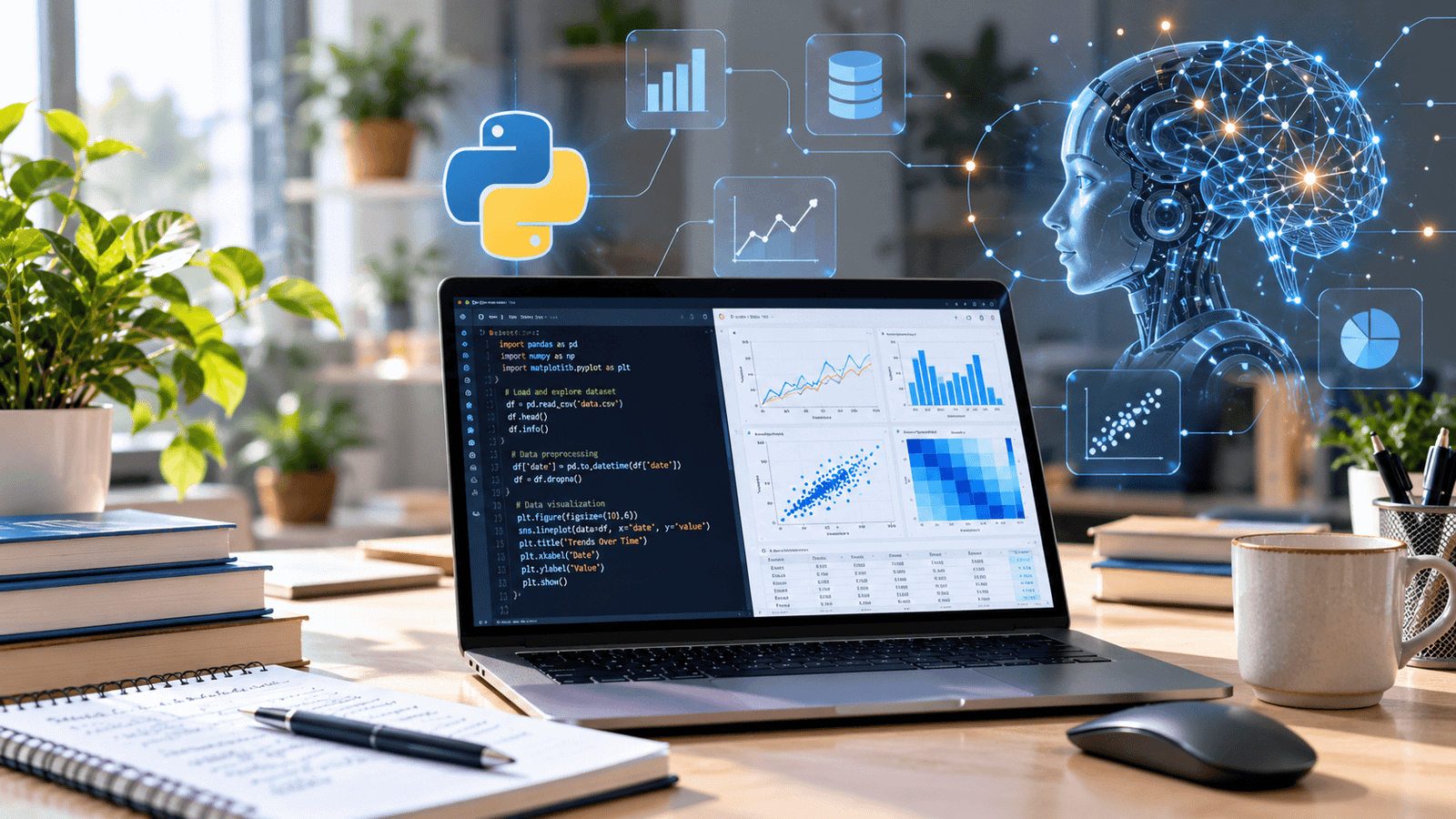
Python for Data Science, AI & Development Coursera: Skills at a Glance
| Skill | What You Can Use It For |
| Python basics | Writing programs and scripts |
| Data structures | Organizing and processing information |
| Functions | Creating reusable code |
| NumPy | Numerical and array-based computing |
| Pandas | Data cleaning and analysis |
| Jupyter | Interactive coding and data exploration |
| Requests/API | Collecting data from online services |
| BeautifulSoup | Extracting information from web pages |
| Exception handling | Managing programming errors |
| Object-oriented programming | Building structured applications |
Who Should Take This Course?
The course can be a suitable starting point for several types of learners.
Beginners in Programming
If you have little or no Python experience, the beginner-level structure can help you establish the fundamentals before moving to advanced topics.
Students Interested in Data Science
Students who want to explore data analysis can use the course as an introduction to Python-based data workflows.
Aspiring AI Learners
If your long-term goal is machine learning or AI, learning Python first can make later technical courses easier to follow.
Working Professionals
Professionals who want to add programming or data skills to their existing toolkit may also find the course useful, particularly if they prefer flexible online learning.
Who Should Not Expect Too Much From It?
It’s important to have realistic expectations. Completing a beginner Python course does not make you a data scientist, AI engineer, or professional developer overnight.
Think of this course as a strong foundation. If you want to become job-ready, you will need additional skills depending on your career path.
For data science, you may need statistics, SQL, data visualization, and machine learning. For AI, you will need to explore areas like machine learning, deep learning, and AI frameworks.
The course gives you a starting point, your practice and projects take you further.
Course Comparison
| Learning Option | Main Focus | Beginner Friendly | Best Use |
| IBM Python for Data Science, AI & Development | Python + data foundations | Yes | Starting Python for data/AI |
| General Python tutorial | Core Python language | Depends on prior programming knowledge | Learning Python fundamentals |
| Python data science course | Data analysis and visualization | Usually | Data-focused learning |
| AI/ML specialization | Machine learning and AI | Usually requires foundations | Advanced AI learning |
| Python development program | Software and application development | Often | Python developer pathway |
The key difference is its focus. The IBM Coursera course connects Python basics with real-world data applications, helping beginners move toward more advanced learning.
Practical Tips to Get More From the Course
1. Do Not Just Watch the Lessons
Typing the code yourself is more valuable than simply watching someone else write it.
Pause the lesson and recreate the examples independently.
2. Change the Examples
If a lesson uses employee data, try creating your own small dataset about books, students, expenses, or products.
Changing the examples forces you to understand the logic instead of memorizing code.
3. Build a Small Project
After learning Pandas, try a simple project such as:
Student Performance Analyzer
You could create a CSV file containing student names and marks, then use Python to:
- Load the data.
- Find the average score.
- Identify the highest score.
- Calculate results by subject.
- Find missing values.
- Create a simple summary.
A small project like this can demonstrate your understanding much better than completing exercises alone.
4. Keep a Python Notes File
Create a simple document containing:
- Important syntax
- Common errors
- Useful functions
- Pandas commands
- NumPy examples
- Questions you want to research later
Over time, this becomes your personal Python reference guide.
5. Continue Learning After the Course
Do not stop after receiving the certificate.
Your next step should depend on your goal.
If you want data science, explore statistics, SQL, data visualization, and machine learning.
If you want AI, move toward machine learning, deep learning, generative AI, and model development.
If you want software development, explore Git, APIs, databases, testing, and Python frameworks.
Certificate and Career Value
The Coursera listing provides a shareable certificate option for the course. A certificate can be useful as evidence that you completed structured learning, and it can be added to a resume or professional profile.
However, a certificate alone is rarely enough to demonstrate practical ability.
A stronger portfolio combines:
Course + Projects + GitHub + Practical Skills
For example, instead of simply writing “Completed Python course” on your resume, you could demonstrate a Python project that cleans a dataset, analyzes it, and presents useful findings.
That gives employers or collaborators something concrete to evaluate.
Pros and Limitations
Pros
- Beginner-friendly starting point
- Focuses on practical Python skills
- Introduces Pandas and NumPy
- Includes Jupyter Notebook work
- Covers APIs and web scraping
- Flexible online learning format
- Certificate option available
Limitations
- It is not a complete data science program
- It does not cover every machine learning concept
- Advanced AI topics require further study
- Programming ability improves mainly through additional practice
- One course cannot replace a complete project portfolio
Our Take
In our view, this course is a great starting point if you’re new to Python. We like that it goes beyond basic coding and introduces tools used in data science and AI. It won’t teach you everything, but it gives you a solid foundation to keep learning and building real projects.
FAQs
1. Is Python for Data Science, AI & Development good for beginners?
Yes. It is a beginner-level course that starts with Python basics and gradually introduces data-related concepts and tools.
2. Do I need Python experience before taking the course?
No. You can start without advanced Python knowledge. Basic computer skills and logical thinking are helpful.
3. Can this course make me a data scientist?
Not by itself. It gives you a strong Python foundation, but you’ll need additional skills such as statistics, SQL, machine learning, and data visualization.
4. Does the course teach AI and machine learning?
It introduces Python skills used in AI and data science, but advanced machine learning and AI require further study.
5. Is the Coursera certificate useful?
Yes, it can show that you completed structured learning. However, adding practical Python projects to your portfolio can make your skills more valuable.
Conclusion
Python for Data Science, AI & Development Coursera can be a useful starting point for learners who want to move from basic programming toward data science, AI, or technical development.
Its biggest value is the foundation it provides. You learn Python fundamentals, data structures, functions, NumPy, Pandas, Jupyter Notebooks, APIs, and web data collection, all skills that can support more advanced learning later.
But remember: finishing a course is the beginning, not the finish line.
The best way to turn Python knowledge into a useful skill is to keep practicing, build projects, solve real problems, and gradually move into the specialization that matches your goals.
Suggested Authoritative External Resources
- Coursera, Python for Data Science, AI & Development
- Python.org, Official Python Documentation
Keep exploring EdTech Vibe for practical guides, AI tools, and the latest insights in education and technology.
About the Author
Divya is an SEO writer and researcher at EdTech Vibe, covering AI, education technology, online courses, programming, and digital learning. She creates simple, practical content to help readers learn and explore technology with confidence.