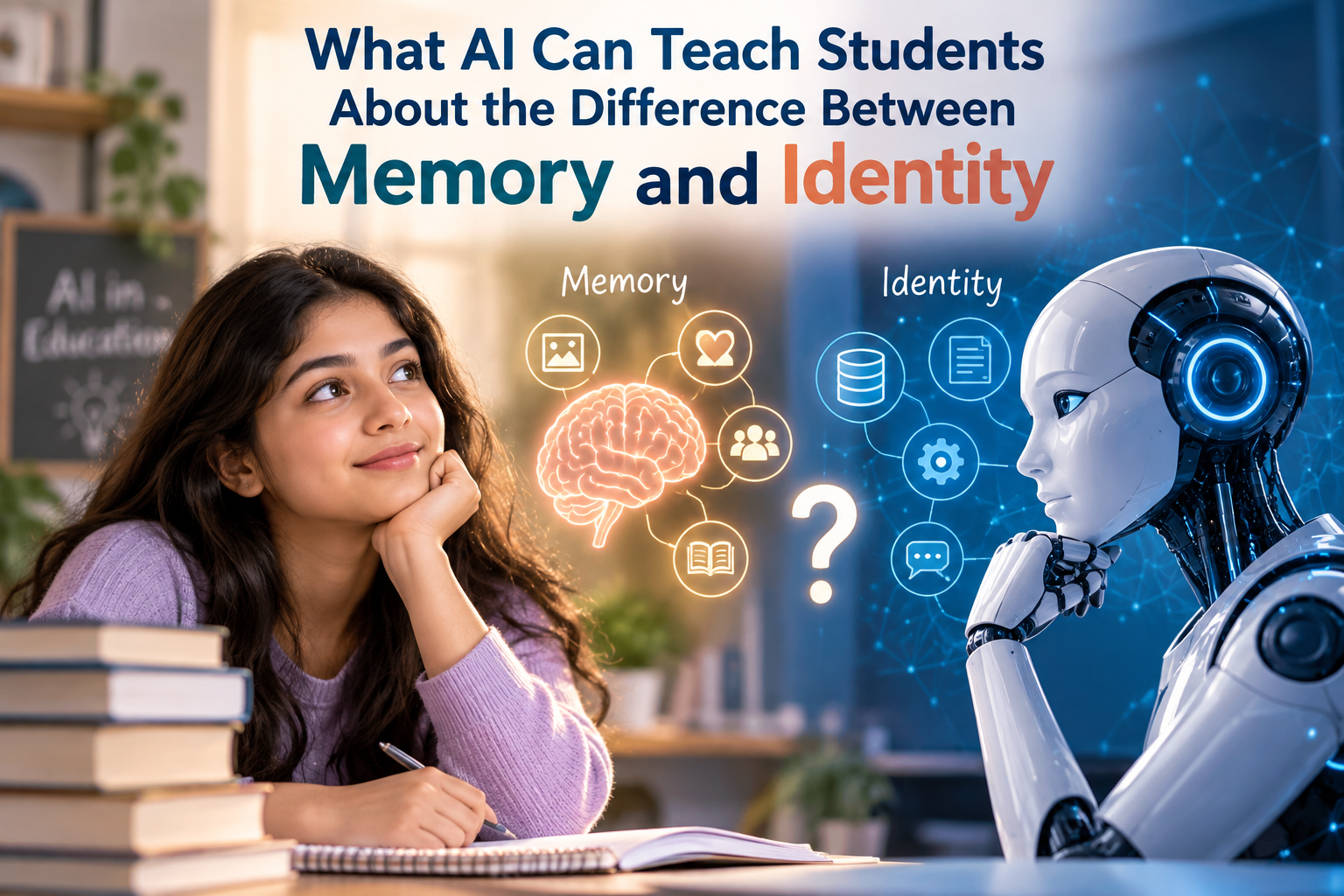
WHAT AI CAN TEACH STUDENTS ABOUT THE DIFFERENCE BETWEEN MEMORY AND IDENTITY
A student asks an AI system a question on Monday. On Friday, the
system remembers the student’s name, the project they are working on,
and perhaps even the mistake they made in last week’s assignment.
Then comes a surprisingly difficult question: if a machine remembers
so much about me, how much of “me” is actually in the machine?
That question belongs in a classroom.
We often teach artificial intelligence as a story about capability:
what a system can generate, summarize, predict or automate. AI also
gives teachers an opportunity to revisit an older scientific problem.
What is memory? What is identity? And why are the two so easy to
confuse?
A MACHINE CAN REMEMBER A FACT WITHOUT REMEMBERING LIKE A HUMAN
When people say that an AI “remembers” them, several different
processes can hide behind that word. A system may retain information
supplied by a user, retrieve earlier conversation history, build a
model of preferences, or infer what kind of answer a user is likely to
prefer.
That can create a strong feeling of continuity. Biological memory,
however, is not a folder of saved conversations.
Human memory depends on living neural systems. Research on memory
engrams examines how populations of neurons participate in storing and
linking experiences. Retrieval can also make a memory temporarily
changeable before it is reconsolidated.
That detail is wonderfully inconvenient. We like to imagine memory as
an archive. Biology gives us something messier: remembering can
involve reconstruction.
A computer record can remain identical each time it is opened. A human
recollection can be influenced by context, emotion, later information
and the act of remembering itself.
For students, that distinction is more useful than memorizing another
definition of AI.
THE PERFECT IMITATION PROBLEM
Imagine that an AI has access to thousands of your messages. It knows
your favorite food, imitates your jokes, predicts which films you will
dislike and recognizes the stories you repeat.
With enough information, it might answer many questions in a way that
sounds remarkably like you.
Has it therefore become you?
Current science does not establish that behavioral imitation transfers
subjective consciousness or personal identity. A model that predicts
someone’s answers with extraordinary accuracy has demonstrated
extraordinary prediction. That result is impressive enough without
giving it a stronger interpretation than the evidence supports.
This becomes a lesson in scientific reasoning.
Observation: the system reproduced a person’s writing style.
Interpretation: the person’s identity was copied.
Those are different statements.
Observation: the system retained autobiographical information.
Interpretation: it possesses human autobiographical memory in the
biological sense.
Again, the second claim requires evidence that the first does not provide.
This habit asking what the evidence actually demonstrates travels
far beyond AI. It belongs in genetics, medicine, psychology and every
field in which an exciting result can grow into an oversized
conclusion.
IDENTITY IS BIGGER THAN A DATABASE
Memory contributes to identity, but identity cannot be reduced neatly
to a list of remembered facts.
A human being has a body, developmental history, relationships,
biological states, sensations and an ongoing interaction with the
world. Even memory itself is distributed across biological processes
rather than stored as a transcript.
Here is a useful classroom thought experiment.
Suppose two digital models are created from exactly the same archive
of one person. At the beginning they are identical. One then has a
long conversation with a family member while the other discusses
science with a colleague. Their histories immediately diverge.
Which model contains the person’s identity? Both? Neither? What
scientific criterion could decide?
A teacher does not need to provide a tidy answer. The educational
value lies in asking students to define their terms and defend the
boundary between data, simulation and identity.
A SIMPLE CLASSROOM EXPERIMENT
Teachers do not need sophisticated software to explore this.
Ask students to imagine that an AI has learned from everything they
wrote during the previous five years and can reproduce their
vocabulary and answer biographical questions with very high accuracy.
Then ask:
What evidence would show that the system remembers information about you?
What additional evidence would be required to say that it remembers as you do?
What experiment could distinguish imitation from identity?
What kinds of claims cannot be established from behavioral similarity alone?
The room becomes interesting when students discover that scientific
questions are not difficult only because answers are unknown.
Sometimes the difficult part is deciding what would count as evidence
for an answer.
That is a lesson in experimental design disguised as a conversation about AI.
THE TEACHER’S ROLE BECOMES MORE IMPORTANT
Generative AI can produce explanations in seconds. That does not
eliminate the teacher’s role; it changes the valuable part of it.
When information is cheap, judgment becomes expensive.
Teachers increasingly need to help students ask: Where did this claim
come from? What observation supports it? What alternative explanation
fits the same evidence? Which word in this sentence quietly makes the
conclusion stronger than the data?
UNESCO’s guidance on generative AI in education emphasizes a
human-centered approach and protection of human agency. That principle
becomes concrete when AI is used not as an oracle, but as an object
students can question.
An AI response can become raw material for scientific criticism.
Ask it to explain memory. Ask students to identify where computer
“memory” and biological memory have been collapsed into one metaphor.
Ask it whether a sufficiently detailed digital model would share the
identity of the original person. Then make students separate what is
experimentally established from philosophical inference and
speculation.
Suddenly, the machine is not doing the thinking for the class.
It has given the class something worth thinking against.
THE QUESTION WORTH LEAVING OPEN
Future AI systems may preserve astonishingly detailed models of
individuals. They may reproduce preferences, stories, humor and
patterns of response with remarkable precision.
Students should be able to appreciate that achievement without
becoming careless about what it means.
A map can become extraordinarily detailed without becoming the country.
A model of a person can become extraordinarily convincing without that
fact alone demonstrating that the person’s identity has been
transferred.
The distinction between memory and identity may sound philosophical,
but the skill required to examine it is deeply scientific: define the
claim, identify the evidence, test alternatives and refuse to let an
exciting conclusion outrun the data.
That may be one of the most useful lessons AI brings into the classroom.
Not because the machine finally tells us what a person is.
Because it forces us to notice how casually we thought we knew.
Selected scientific background:
Choucry, Nomoto & Inokuchi, “Engram mechanisms of memory linking and
identity,” Nature Reviews Neuroscience (2024).
Tronson & Taylor, “Molecular mechanisms of memory reconsolidation,”
Nature Reviews Neuroscience.
UNESCO, Guidance for Generative AI in Education and Research.
Author: Kasem Jamil Al-Saloumi
MSc Biotechnology (DNA Technology)
Biology Educator & Scientific Research Coordinator
Doha, Qatar