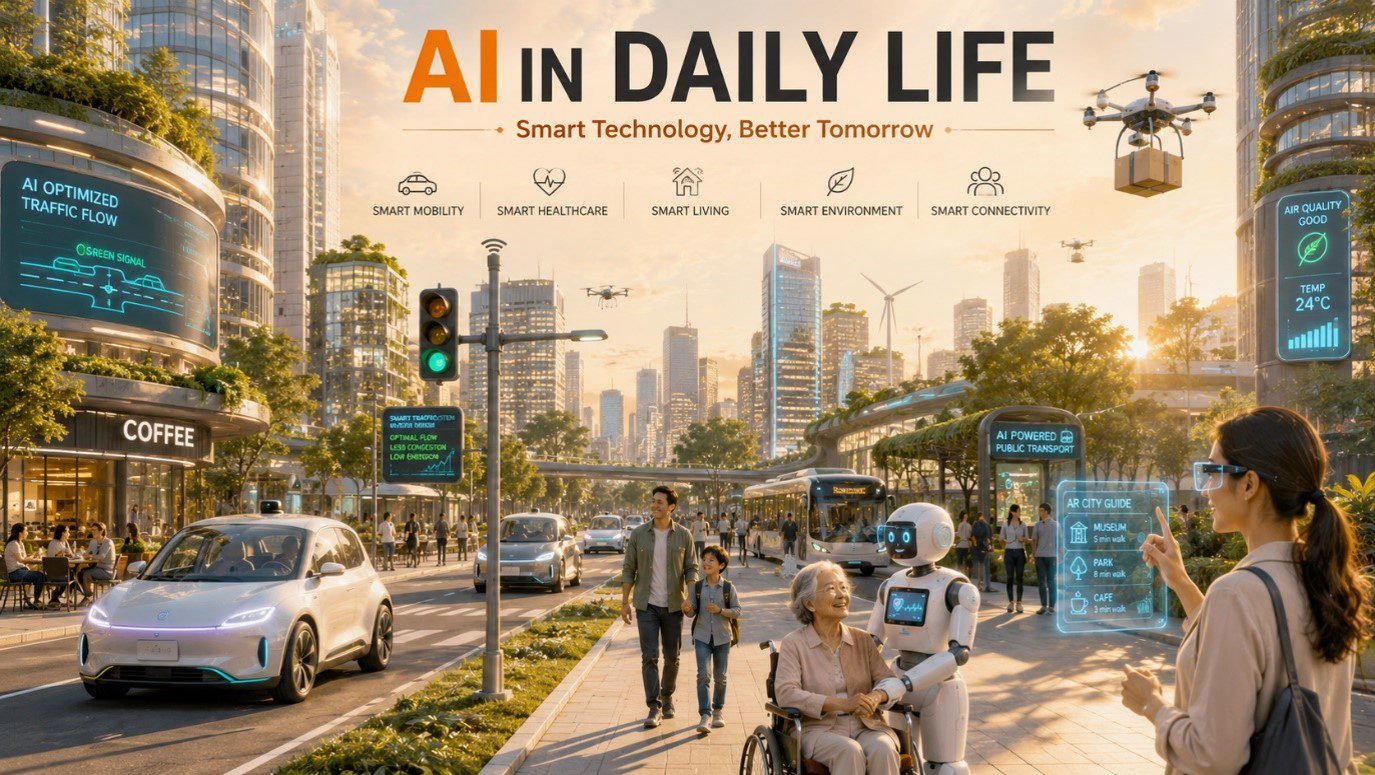
Think about the first thing you did this morning. Maybe you unlocked your phone with your face, asked your virtual assistant about the weather, checked personalized social media feeds, or watched a recommended video while drinking your coffee. Without realizing it, you were already interacting with AI in daily life.
Artificial Intelligence is no longer a futuristic concept reserved for scientists or technology companies. It has quietly become a part of our routines, helping us make decisions, save time, and simplify tasks that once required much more effort. From online shopping recommendations to navigation apps that avoid traffic jams, AI works behind the scenes almost every moment.
Some people still imagine robots taking over the world when they hear the word “AI,” but the reality is much simpler and much more personal. AI is designed to understand patterns, learn from data, and make intelligent suggestions that improve our everyday experiences.
In this article, we will explore how artificial intelligence in everyday life is transforming our homes, workplaces, healthcare, education, entertainment, and even the way we connect with loved ones. Along the way, we will also discuss its benefits, challenges, and why understanding AI today is more important than ever.
What Is AI in Daily Life?
Artificial Intelligence refers to computer systems that can perform tasks requiring human-like intelligence, such as recognizing speech, solving problems, learning from experience, and making predictions.
The best part is that you don’t need to be a programmer to benefit from AI. Every time your email filters spam, your phone suggests the next word while typing, or your music app recommends a new playlist, AI is working for you.
Instead of replacing humans, most AI tools today act as assistants that make our lives easier and more efficient.
AI at Home: Making Everyday Living Easier
Modern homes have become smarter thanks to AI-powered devices.
Smart speakers can answer questions, control lights, play music, or remind you about appointments. Robot vacuum cleaners map your rooms and clean efficiently without much supervision. Smart thermostats learn your preferences and automatically adjust temperatures to save energy.
Even kitchen appliances are becoming intelligent, helping people cook better meals while reducing waste.
For busy families, these small conveniences add up, creating more time for meaningful moments together.
AI in Smartphones
Your smartphone is probably the device where you interact with AI the most.
Features like:
- Face recognition for unlocking
- Voice assistants
- Camera enhancements
- Predictive text
- Real-time translation
- Spam call detection
are all powered by artificial intelligence.
The camera that automatically adjusts lighting or removes background noise during calls isn’t magic, it’s AI analyzing information in milliseconds.
Without noticing it, millions of people rely on AI dozens of times every single day.
AI in Healthcare
Healthcare has experienced one of the biggest transformations through AI.
Doctors now use AI systems to analyze medical images, detect diseases earlier, and assist in diagnosing conditions with greater accuracy. Hospitals use predictive analytics to improve patient care and manage resources efficiently.
Wearable devices monitor heart rate, sleep quality, and physical activity, alerting users when something unusual happens.
For many patients, early detection can literally save lives.
AI doesn’t replace doctors but provides them with better tools to make informed decisions.
AI in Education
Learning has become more personalized than ever before.
Educational platforms analyze student performance and recommend lessons based on strengths and weaknesses. Language learning apps adjust difficulty levels according to progress, while AI tutors provide instant feedback.
Students no longer have to learn at the same pace as everyone else. Instead, technology adapts to individual needs.
Teachers also benefit by automating grading and administrative tasks, giving them more time to focus on teaching.
AI in Transportation
Navigation apps use AI to analyze live traffic conditions and suggest the fastest routes.
Ride-sharing services predict demand, estimate arrival times, and optimize driver locations using machine learning algorithms.
Modern vehicles include intelligent safety features like:
- Lane departure warnings
- Automatic emergency braking
- Adaptive cruise control
- Driver fatigue monitoring
These innovations help reduce accidents and make traveling safer for everyone.
AI in Shopping
Online shopping has become highly personalized because of AI.
Have you ever wondered how websites recommend products you actually like?
AI studies browsing habits, previous purchases, and customer preferences to suggest relevant items.
It also powers:
- Personalized discounts
- Chatbots for customer support
- Inventory management
- Fraud detection
- Dynamic pricing
For businesses, AI improves efficiency. For customers, it creates a smoother shopping experience.
AI in Entertainment
Streaming platforms know what you might enjoy before you even search.
Movie recommendations, personalized playlists, gaming experiences, and video suggestions all rely heavily on AI.
Content creators also use AI tools for editing videos, generating captions, improving audio quality, and creating visual effects.
This technology helps creators spend less time on repetitive tasks and more time producing meaningful content.
AI at Work
The workplace is evolving rapidly with AI automation.
Many repetitive tasks like scheduling meetings, organizing emails, analyzing spreadsheets, and generating reports can now be completed much faster.
Professionals across industries use AI as a productivity partner rather than a replacement.
Writers brainstorm ideas, designers generate concepts, marketers analyze campaigns, and programmers receive coding assistance, all with AI support.
The goal isn’t to eliminate human creativity but to amplify it.
AI in Banking and Finance
Banks use AI to detect suspicious transactions and prevent fraud before customers even notice unusual activity.
Loan approvals, investment recommendations, credit scoring, and customer service have become more efficient thanks to intelligent algorithms.
Many budgeting apps analyze spending habits and help users save money through personalized insights.
These systems improve financial security while making services faster and more accessible.
AI and Social Media
Every social media feed is carefully curated by AI.
It decides which posts appear first, recommends new accounts to follow, filters harmful content, and suggests advertisements based on user interests.
While this personalization keeps users engaged, it also raises questions about privacy and information bubbles.
Understanding how algorithms work helps people make more informed choices online.

Emotional Impact of AI in Our Lives
Technology often feels cold and mechanical, but AI has also created deeply human moments.
A visually impaired person using AI-powered navigation gains independence.
An elderly individual living alone can receive medication reminders and emergency assistance through smart devices.
Parents separated by distance can instantly translate conversations with relatives who speak another language.
Students struggling with confidence receive personalized support instead of falling behind.
Behind every algorithm is the possibility of making someone’s life a little easier, a little safer, or a little happier.
That’s perhaps the most powerful aspect of AI,it serves people when designed responsibly.
Challenges and Concerns
Despite its many advantages, AI isn’t perfect.
Some major concerns include:
Privacy
AI systems collect large amounts of personal data, raising questions about how information is stored and used.
Bias
If AI learns from biased data, it can produce unfair results that affect hiring, lending, or healthcare decisions.
Job Changes
Automation may replace certain repetitive jobs while creating demand for entirely new skills.
Security
Cybercriminals can misuse AI for scams, fake content, or sophisticated attacks.
Responsible development and ethical guidelines are essential to ensure AI benefits society fairly.
The Future of AI in Daily Life
The role of AI will only continue growing.
Future innovations may include smarter homes, personalized healthcare plans, AI-powered teachers, autonomous transportation, and even more advanced digital assistants that understand emotions and context.
Instead of fearing these changes, learning how to use AI responsibly can open new opportunities for individuals and businesses alike.
The people who adapt and develop AI-related skills today are likely to thrive in tomorrow’s world.
Final Thoughts
AI in daily life is no longer something we should think of as tomorrow’s technology, it is today’s reality. It quietly helps us navigate roads, communicate with loved ones, manage finances, learn new skills, and make countless small decisions every day.
What makes AI truly remarkable isn’t its complexity but its ability to improve ordinary moments. Whether it’s helping a student understand a difficult lesson, guiding a doctor toward an early diagnosis, or simply recommending the perfect song after a long day, artificial intelligence has become part of our human experience.
Of course, challenges like privacy, ethics, and responsible use deserve careful attention. But with thoughtful development and informed users, AI has the potential to become one of humanity’s greatest tools rather than something to fear.
The future isn’t about humans versus machines. It’s about humans working alongside intelligent technology to create a smarter, safer, and more connected world.
FAQs
1. What is AI in daily life?
AI in daily life means using smart technology in everyday tasks like smartphones, online shopping, navigation, healthcare, and smart homes.
2. How does AI help people?
AI saves time, automates routine tasks, improves decisions, and offers personalized experiences that make life easier.
3. Is AI replacing jobs?
AI is changing many jobs by handling repetitive work, but it is also creating new opportunities that require human skills and creativity.
4. Where is AI used every day?
AI is used in voice assistants, search engines, social media, banking apps, streaming platforms, navigation, and online shopping.
5. Is AI safe to use?
Yes, AI is generally safe when used responsibly, but users should stay aware of privacy, security, and ethical considerations.