AI has revolutionized the way education is delivered, and chat gpt for teachers has been one of the most transformative inventions in modern teaching. As we approach 2026, educators are increasingly employing AI not only to make their jobs easier but also to enhance lesson plans, increase student engagement, and deliver personalized educational experiences.
With features like creating quizzes in seconds and assisting students with complex concepts, ChatGPT is altering the landscape of education. If you are a school teacher, online educator, tutor, blogger, or content creator, gaining insights into AI’s role in education could prove invaluable.
This article will provide an overview of the application of ChatGPT by teachers in 2026, its advantages, real-life applications, Advantages and Disadvantages, and how to effectively implement it in classrooms.
Table of Contents
- What Is ChatGPT for Teachers?
- Why Teachers Are Using AI in 2026
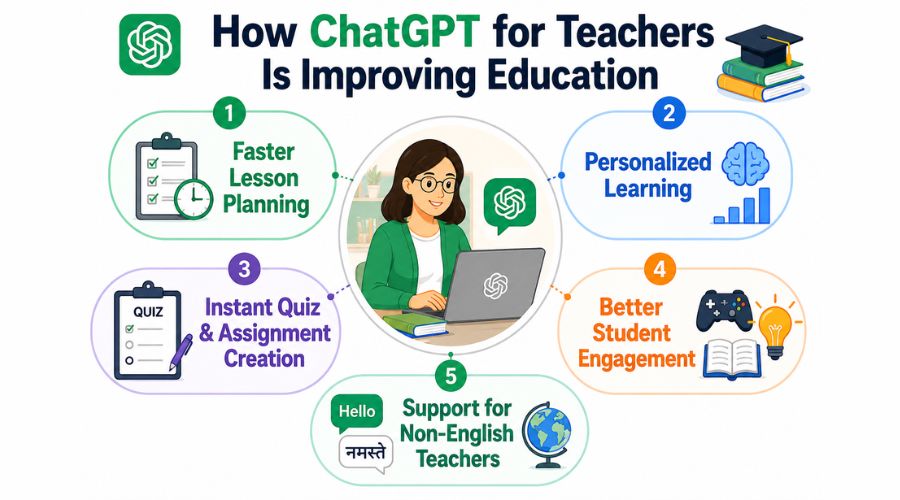
- How Chat GPT for Teachers Is Improving Education
- Best Features of ChatGPT for Teachers
- Real-World Use Cases
- Benefits of Using ChatGPT in Education
- Advantages and Disadvantages
- Tips to Use ChatGPT Effectively
- Common Mistakes Teachers Should Avoid
- Future of AI in Education
- FAQs
- Conclusion
What Is ChatGPT for Teachers?
OpenAI developed ChatGPT as an advanced AI chatbot that helps users generate human-like responses, create content, answer questions, and automate tasks.
For teachers, ChatGPT acts like a digital teaching assistant. It can help with:
- Lesson planning
- Quiz generation
- Homework ideas
- Student feedback
- Classroom activities
- Presentation outlines
- Writing assistance
- Personalized learning support
In simple words, ChatGPT helps teachers work smarter instead of spending hours on repetitive tasks.
Why Teachers Are Using AI in 2026
The education industry is rapidly adopting AI tools because teachers are facing increasing workloads. Many educators spend more time planning and grading than actually teaching.
Many teachers spend hours every week creating lesson plans, assignments, and classroom activities manually. ChatGPT helps automate these repetitive tasks, allowing educators to focus more on teaching and student interaction.
| Task | Traditional Time | With ChatGPT |
| Lesson Planning | 2–3 Hours | 15–20 Minutes |
| Quiz Creation | 1 Hour | 5 Minutes |
| Writing Feedback | 30 Minutes | 5–10 Minutes |
| Classroom Activities | 1 Hour | Instant Ideas |
This time-saving advantage is one reason why AI tools for education are becoming extremely popular.
Growing AI Trends in Education
Some major trends include:
- AI-generated lesson plans
- Personalized student learning
- Smart tutoring systems
- Automated grading
- AI classroom assistants
- Voice-based learning support
Schools and online educators are increasingly using AI to improve learning outcomes and reduce teacher burnout.
How Chat GPT for Teachers Is Improving Education
1. Faster Lesson Planning
One of the biggest advantages of chat gpt for teachers is lesson planning.
Teachers can simply type:
“Create a 45-minute science lesson plan for Grade 6 students on climate change.”
Within seconds, ChatGPT generates:
- Learning objectives
- Activities
- Discussion questions
- Homework ideas
- Assessment methods
This allows teachers to spend less time preparing materials and more time helping students learn effectively.
2. Personalized Learning for Students
Every student learns differently. Some students understand quickly, while others need simpler explanations.
ChatGPT can:
- Simplify difficult topics
- Create personalized worksheets
- Generate different difficulty levels
- Translate explanations into simpler English
For example:
A math teacher can ask:
“Explain algebra for beginners using real-life examples.”
This helps students understand concepts more easily.
3. Instant Quiz and Assignment Creation
Teachers no longer need to spend hours creating test papers.
ChatGPT can instantly generate:
- Multiple-choice questions
- True/False quizzes
- Fill-in-the-blanks
- Descriptive questions
- Homework assignments
Example Prompt
“Create 10 multiple-choice questions about World War II for Class 9 students.”
This feature is especially useful for online educators and coaching teachers.
4. Better Student Engagement
Modern students are more engaged when lessons are interactive, creative, and technology-driven.
Teachers are using ChatGPT to create:
- Story-based lessons
- Educational games
- Debate topics
- Interactive classroom activities
- Creative writing prompts
This keeps students engaged and improves participation.
5. Helping Non-English Teachers
Teachers who are not fluent in English use ChatGPT to:
- Improve grammar
- Rewrite lesson notes
- Create professional emails
- Translate educational content
This is especially useful for teachers in multilingual classrooms.
Best Features of ChatGPT for Teachers
AI-Powered Content Creation
ChatGPT can create:
- Worksheets
- Presentations
- Notes
- Summaries
- Study guides
Smart Classroom Assistance
Teachers can use AI to:
- Answer student questions
- Create project ideas
- Generate classroom discussion topics
Time Management
Instead of spending hours writing documents manually, teachers can automate repetitive tasks.
24/7 Teaching Support
ChatGPT works anytime, making it useful for online tutors and remote educators.
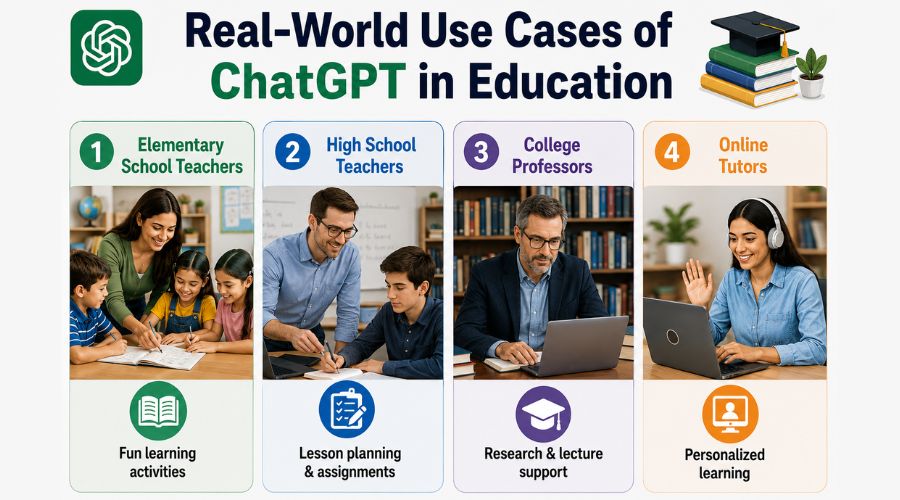
Real-World Use Cases of ChatGPT in Education
Elementary School Teachers
Use ChatGPT for:
- Fun learning activities
- Storytelling exercises
- Reading comprehension quizzes
High School Teachers
Use AI tools for:
- Complex lesson planning
- Debate preparation
- Assignment generation
College Professors
Use ChatGPT to:
- Create lecture summaries
- Develop research outlines
- Generate discussion questions
Online Tutors
AI helps online tutors create:
- Personalized learning paths
- Practice worksheets
- Student performance feedback
Benefits of Using ChatGPT in Education
One of the biggest reasons teachers are adopting AI tools is the ability to save time while improving teaching quality. ChatGPT helps educators simplify daily tasks and create better learning experiences.
1. Saves Time
Teachers can automate repetitive work and focus more on students.
2. Improves Creativity
AI-generated ideas help teachers create more engaging lessons.
3. Reduces Stress
Reducing repetitive work helps teachers avoid stress and classroom burnout.
4. Supports Different Learning Styles
Teachers can create visual, textual, and simplified learning materials.
5. Beginner-Friendly
Even non-technical teachers can use ChatGPT easily.
Advantages and Disadvantages of ChatGPT for Teachers
| Advantages | Disadvantages |
| Saves hours of work | Sometimes gives inaccurate information |
| Helps create personalized lessons | Students may misuse AI |
| Improves classroom engagement | Requires internet access |
| Easy to use | Teachers still need fact-checking |
| Supports creativity | Cannot replace human teaching |
Although ChatGPT offers many advantages, teachers should still review AI-generated content carefully before using it in classrooms.
Tips to Use ChatGPT Effectively as a Teacher
1. Use Detailed Prompts
Better prompts give better results.
Example:
Simple Prompt – “Create a lesson plan.”
Detailed Prompt – “Create a 40-minute biology lesson plan for Grade 8 students with activities and homework.”
2. Always Verify Information
ChatGPT can occasionally generate outdated or incorrect information, so fact-checking is always important.
Teachers should always:
- Check facts
- Review answers
- Edit generated content
3. Combine AI With Human Teaching
ChatGPT should assist teachers, not replace them.
Human interaction, emotional support, and classroom management are still essential.
4. Use AI for Brainstorming
Teachers can use ChatGPT to generate:
- Creative ideas
- Classroom games
- Group activities
- Discussion topics
Common Mistakes Teachers Should Avoid
Over-Reliance on AI
Depending completely on AI may reduce creativity and critical thinking.
Copy-Pasting Without Editing
Always personalize generated content.
Ignoring Student Privacy
Never share confidential student information with AI tools.
Using Generic Prompts
Specific prompts provide higher-quality results.
Future of AI in Education
Experts believe AI-powered education tools will continue improving personalized learning, smart tutoring systems, and virtual classrooms over the next few years.
Experts predict that by 2030:
- AI tutors will become common
- Personalized learning will improve dramatically
- Teachers will spend less time on administration
- Virtual classrooms will become smarter
However, human teachers will remain irreplaceable because emotional intelligence and real classroom interaction cannot be fully automated.
AI is expected to become a supportive partner for educators rather than a replacement.
Best AI Prompts for Teachers in 2026
Here are some useful prompts teachers can try:
Lesson Planning Prompt
“Create a beginner-friendly history lesson plan for Class 7 students on the Industrial Revolution.”
Quiz Creation Prompt
“Generate 15 MCQs with answers on photosynthesis.”
Classroom Activity Prompt
“Suggest 5 fun classroom activities for teaching grammar to middle school students.”
Homework Prompt
“Create a homework worksheet for Grade 5 mathematics with answers.”
FAQs About Chat GPT for Teachers
1. Is ChatGPT good for teachers?
Yes, ChatGPT helps teachers save time, create lesson plans, generate quizzes, and improve classroom engagement.
2. Can teachers use ChatGPT for lesson planning?
Absolutely. Teachers can generate complete lesson plans, activities, and assessments within minutes.
3. Is ChatGPT free for teachers?
ChatGPT offers both free and paid plans. Many teachers use the free version for daily classroom tasks.
4. Can ChatGPT replace teachers?
No. AI can support education, but human teachers are essential for emotional connection, classroom management, and personalized guidance.
5. What are the best uses of ChatGPT in education?
The best uses include:
- Lesson planning
- Quiz creation
- Homework assistance
- Personalized learning
- Classroom activity generation
Conclusion
Chat gpt for teachers in 2026 will revolutionize education. Educators can do more with less thanks to automation. With the help of artificial intelligence, educators can design better lesson plans, interact with students, and concentrate more on teaching.
Although AI technology may have its own set of constraints, there are several advantages that should be considered. The best strategy is to become familiar with ChatGPT and utilize it effectively in order to have an edge in the world of education.
Are you a teacher, blogger, content creator, or instructor? This is the right time for you to dive into AI-powered instruction tools and enhance your teaching process.
Explore more AI teaching tools and education guides on Ed Tech Vibe to stay ahead in the future of education.